
Checking Criminal History in Arizona
Start an Arizona criminal history search by naming the question. A person reviewing their own fingerprint-linked statewide record uses the Arizona DPS Record Review process. Someone tracing a court case starts with Arizona Judicial Branch Public Access, then goes to the court that owns the file. A recent arrest calls for the sheriff roster in the county of booking and the arresting agency's report. State prison custody belongs in ADCRR Inmate Data Search. The Arizona Sex Offender Registry serves a narrower public-safety purpose.
Gather a full legal name, likely name variants, date of birth when a system permits it, the event county, and an estimated date. Case numbers, booking numbers, and report numbers are much safer than a common name. Each result is a lead until the source office confirms both identity and outcome. Arizona DPS does not sell the public a statewide rap-sheet search for another person.
- Choose the Arizona system that holds the record type, rather than sending a broad request to DPS.
- Search with the strongest identifier available and save the court, agency, county, and record number.
- For arrests, jail entries, police reports, and case documents, open the Arizona county directory.
- Compare the intake charge with the filed charge and final disposition before reaching a conclusion.
- For errors in a personal rap sheet, obtain proof from the source court or agency and use the DPS challenge path.
Arizona Has No Public Name Check
A common mistake is looking for one Arizona portal that returns every arrest and conviction by name. That product does not exist. Arizona law permits a subject to review their own Central State Repository record and lets authorized agencies obtain fingerprint results when a specific legal authority applies. It does not give private citizens a pay-per-name search of other people's DPS rap sheets.
The public route uses four separate layers. Court indexes locate filed cases. County clerks provide the official docket and documents. Sheriffs and police agencies provide booking and incident material. Arizona DPS provides personal record review, the warrant search, crime statistics, and other purpose-specific services. These layers can disagree because they update on different clocks. A blank statewide result can reflect an excluded court, weekly lag, an unmapped name, or the wrong record system.
For an Arizona record review, the DPS Central State Repository instructions offer an online Public Services Portal route and a mail packet. The official page shown below centers accuracy, completeness, and challenge rights, not public screening of another person.
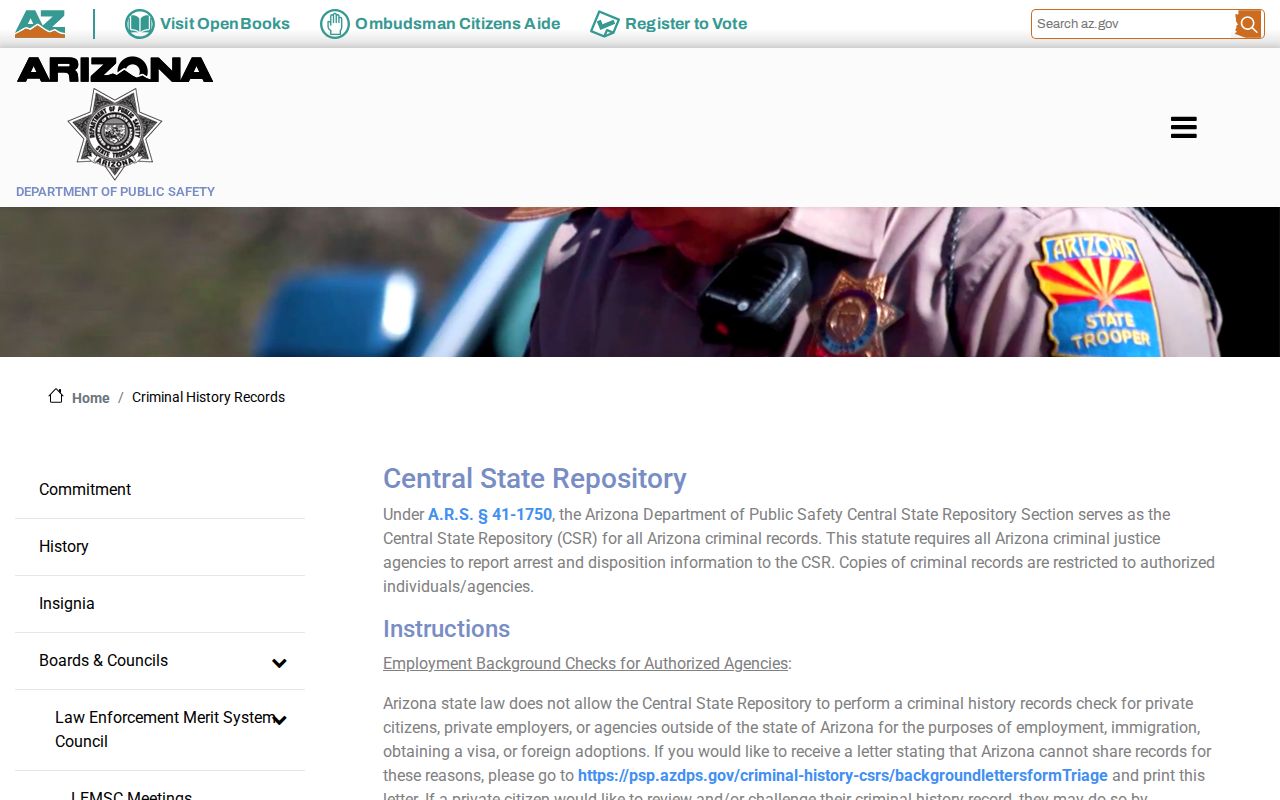
The captured page helps distinguish a fingerprint-based personal review from the public court and county searches used for other questions.
Inside the Arizona Criminal History Repository
The Arizona Department of Public Safety, Criminal Justice Services Bureau, Central State Repository Section keeps the state's fingerprint-linked criminal history. A.R.S. § 41-1750 requires criminal justice agencies to report qualifying arrests and dispositions. Fingerprints let Arizona DPS connect an arrest cycle to an identity more reliably than a name alone. The repository may hold identity data, arrest charges, the reporting agency, prosecutor action, a court case number, and a disposition when the source office sent it.
The repository is a compiled record, not a copy of every police report or court file. Arresting agencies own their reports. County clerks own felony case documents and certified dispositions. Arizona DPS can correct its compilation after the source office supplies authoritative support, but it cannot casually rewrite a court judgment. The Arizona DPS criminal records agency profile walks through each product, fee, and correction route.
Individuals may start their own review through the Arizona DPS Public Services Portal or use a mail packet with a completed fingerprint card. DPS states that its review is free, though the service taking the prints may charge. A complete mailed packet receives a response by mail within 15 days.
How Arizona Records Reach DPS
One arrest can create several Arizona records. The officer makes an incident or arrest report. The booking agency records intake charges, bond, fingerprints, and custody. A prosecutor may reject, replace, or narrow those charges. The court then records the complaint, information, or indictment and the final result. Each office owns its part of the chain.
Arrest → Booking and fingerprints → Prosecutor filing → Court disposition → Arizona DPS rap sheet
Arizona's Automated Biometric Identification System supports the fingerprint identity. The Arizona Computerized Criminal History repository holds the compiled history. The restricted Arizona Disposition Reporting System helps courts and prosecutors send outcomes for arrests dated on or after February 1, 2007. ADRS work data purges 31 days after its last charge update, while the resulting history remains governed in ACCH.
Reporting gaps can leave an arrest cycle open after the court has finished the case. Missing process-control numbers, name changes, incomplete prints, or delayed clerk reporting can also break the link. The practical fix is to get a certified disposition from the county clerk, correct the source file if needed, and then challenge the personal Arizona DPS record.
Note: A county court disposition is stronger proof of an outcome than an intake charge or an unfinished repository cycle.
Arizona Statewide Record Systems
Arizona's statewide systems answer distinct questions. Public Access is a broad court index, but it does not include every court, case, or charge and is not the official record. eAccess provides unrestricted Superior Court documents within its date coverage. ADCRR Inmate Data Search covers sentenced state prisoners, not people held in county jail. OffenderWatch publishes only the part of the registry that Arizona law makes public.
The Central State Repository differs from all four. It compiles fingerprint-supported criminal history for authorized use and a subject's own review. No one system replaces the local file. The county of filing remains the source for a certified disposition, while the arresting agency remains the source for its report.
| System | What It Holds | Run By |
|---|---|---|
| Arizona DPS Record Review | Subject's fingerprint-linked repository history | Arizona DPS |
| ADCRR Inmate Data Search | Sentenced Arizona state prisoners | ADCRR |
| Arizona OffenderWatch | Statutorily published registry profiles | Arizona DPS and county sheriffs |
| Public Access and eAccess | Court index and eligible Superior Court documents | Arizona Judicial Branch |
Arizona Jail and Prison Records
Custody searches split three ways in Arizona. County sheriffs run local jails for people awaiting trial, awaiting transfer, or serving qualifying local terms. Arizona has no single county-jail roster, so a recent custody check starts with the county where the arrest occurred. The Arizona Department of Corrections, Rehabilitation & Reentry holds sentenced state prisoners. Federal Bureau of Prisons records cover federal custody.
ADCRR Inmate Data Search can show an ADC number, status, location, commitment county, sentence information, and release or community-supervision dates when published. ADCRR cautions users to verify offense details with the court. The department listed nine state-run complexes and six private facilities in the research inventory. Its June 30, 2025 fact sheet counted 35,552 confined people.
If a person vanishes from a jail list, check for release, a spelling variation, transfer to ADCRR, federal custody, or another county. VINELink's Arizona state-selection service may support custody status notices for participating agencies.
The captured state selector is a notification entry point, not a complete Arizona arrest history or court docket.
Types of Arizona Criminal Records
Arizona criminal records are defined by who creates them and what event they describe. An incident report preserves the investigating agency's account. A booking record tracks custody. A case file shows the legal prosecution. A rap sheet compiles fingerprint-linked cycles. Warrants, supervision files, prison profiles, and registry listings add purpose-specific facts. Reading one as though it were another creates false matches and wrong outcomes.
- Arrest and booking records: The police or sheriff documents the event, while the jail tracks intake, bond, housing, release, or transfer.
- Criminal court case files: Municipal, Justice, and Superior Court clerks keep complaints, dockets, pleas, judgments, sentences, and public filings.
- Repository rap sheets: Arizona DPS compiles reportable fingerprint-linked arrests and the dispositions supplied by prosecutors and courts.
- Warrants: The issuing court owns the order, even when a statewide DPS search provides a useful lead.
- Supervision and registry records: County probation, ADCRR community supervision, clemency records, and OffenderWatch each describe a narrow legal status.
The same event may appear in several of these sources. Match the case number, agency, dates, and final charge. Do not treat a booking allegation as a conviction or a registry profile as a full criminal history.
Arizona Arrest Data in Context
Arizona DPS coordinates the state's Uniform Crime Reporting program through the Theme-Oriented Public Site, known as TOPS. The official 2024 Arizona Crime Overview reported 149,758 arrests and an arrest rate of 1,973.18 per 100,000. That was 13.26 percent above the 2023 rate. These figures count reported arrest events, not unique people and not convictions.
Participation also matters. TOPS depends on agency submissions, current-year data can be incomplete, and differences between summary reporting and NIBRS can affect comparisons. A statewide total cannot prove that a named person was arrested, nor can it replace a county booking record. Its value is context: it shows the scale and categories of activity reported through Arizona's crime-data network.
The Arizona DPS 2024 crime overview presents the statewide offense and arrest indicators used here.
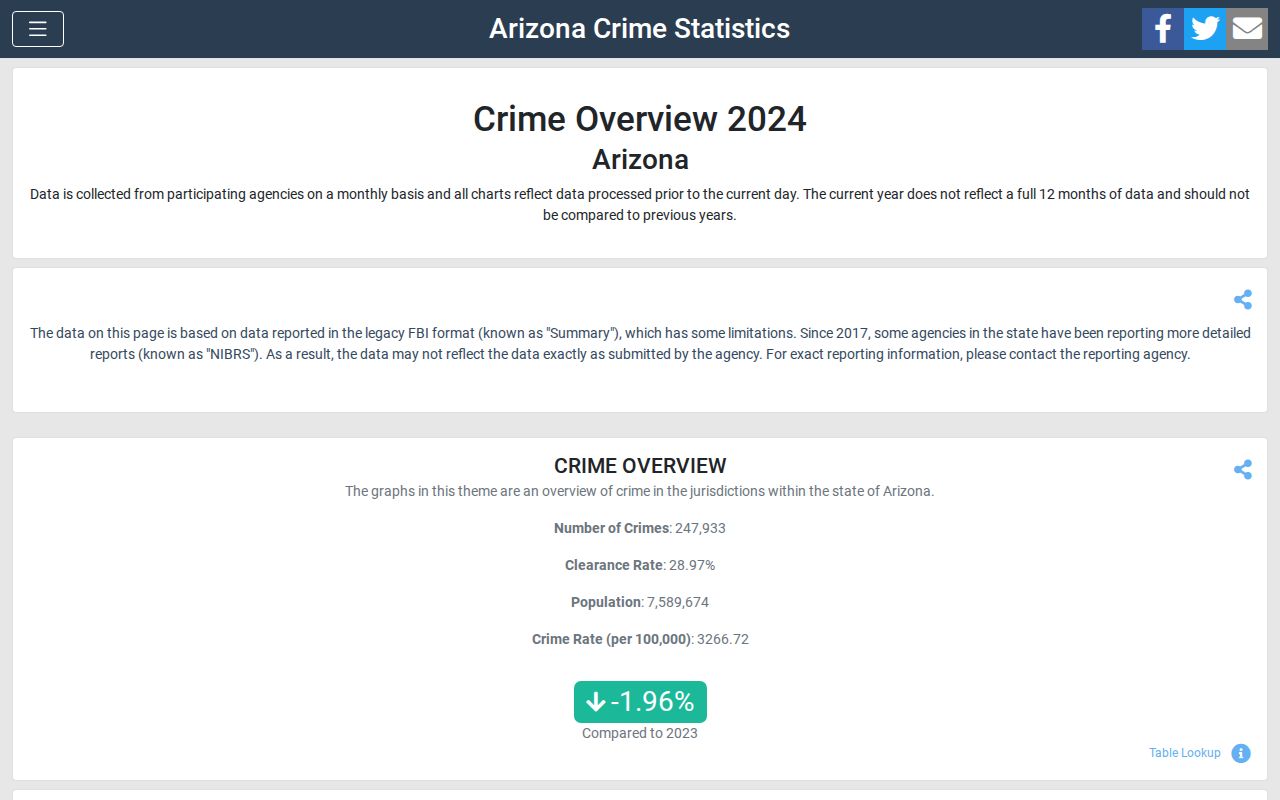
The dashboard view is statistical context only, so a record search must still return to the agency and court that created the individual files.
Arizona Public Access Laws
Arizona Public Records Law begins with a broad inspection right, but record type and custodian still control access. A request for a DPS trooper's incident report differs from a request for a county sheriff booking file, a court docket, or Central State Repository information. A.R.S. § 41-1750 restricts criminal-history dissemination even when another agency record about the same event may be public.
Arizona Supreme Court Rule 123 governs access to judicial records. Public Access excludes sealed cases, juvenile delinquency matters, protection-order information, and other protected material. Victim data, Social Security numbers, active investigative facts, and security-sensitive details may be removed while the rest is released. Precise requests work best: name the report or case, date range, agency, record number, and public portion sought.
Key Arizona authorities:
A.R.S. § 39-121 establishes public inspection unless another law or protected interest applies.
A.R.S. § 39-121.01 addresses custody, prompt access, copies, and request duties.
A.R.S. § 41-1750 creates the Central State Repository and controls reporting and dissemination.
A.R.S. § 41-1756 penalizes unauthorized access to or use of criminal-history information.
A.R.S. § 13-911 provides the Arizona process for sealing qualifying case records.
Arizona DPS Warrant Search
Arizona DPS now offers a free statewide warrant search using first name, last name, and exact date of birth. It returns no more than five results. The tool is a lead, not a real-time command. A recalled or quashed warrant may not yet be reflected, and identity matching can be wrong. Confirm every result with the issuing court before acting on it.
Bench warrants often arise in Municipal or Justice Court after a missed appearance or failure to comply. Felony warrants appear in Superior Court matters. Public Access may show a related docket event, but that index updates weekly and omits some local ordinance matters. Resolution belongs with the issuing court, which controls appearance, recall, bond, or surrender terms.
The official Arizona DPS warrant form displays the required identity fields and its verification warning.
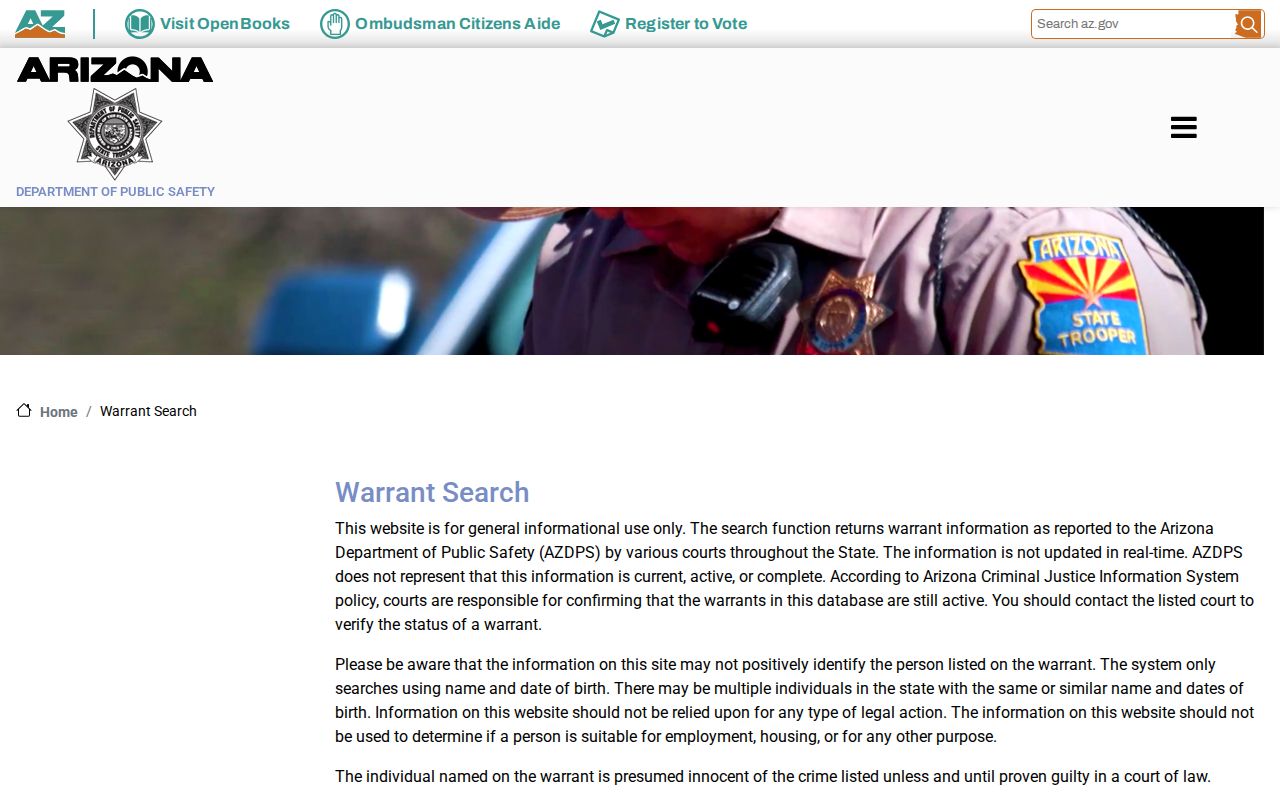
The form's statewide reach is useful, but county and city courts remain the authoritative source for current warrant status.
Active-warrant caution: Contact the issuing court or a lawyer before appearing in person when custody or bond consequences are unclear.
Three Arizona Record Remedies
Arizona uses three different remedies that should not be merged under one label. Sealing under A.R.S. § 13-911 can restrict public access to qualifying arrest, conviction, and sentencing records. Setting aside a judgment under § 13-905 releases specified penalties and adds a notation, but the case remains visible. Marijuana expungement under § 36-2862 applies only to qualifying pre-Proposition 207 conduct and has its own legal effect.
- Sealing
- A petition-based limit on public access to qualifying Arizona case records, subject to statutory exclusions and official access.
- Set-aside
- An order that annotates a conviction and releases specified penalties or disabilities without erasing the public file.
- Marijuana expungement
- A separate remedy for qualifying marijuana conduct under the voter-approved statutory process.
Each filing goes to the court tied to the case or arrest, not to Arizona DPS first. The prosecutor and victims may receive notice where the statute provides. After relief, check the county court, then obtain a personal DPS review. If an eligible entry did not update correctly, use the court order in the repository challenge process.
The Arizona Judicial Branch publishes statewide sealing forms and instructions for A.R.S. § 13-911.
The forms create a statewide starting point, while filing and certified copies still run through the Arizona court connected to the record.
Arizona Probation and Supervision
Probation and post-prison supervision are separate Arizona systems. Adult probation is a Judicial Branch function administered through each county Superior Court's probation department. No complete public statewide probationer name search was found. Start with the sentencing court docket, then ask that county's probation office for information it may lawfully release.
ADCRR Community Corrections supervises qualifying people after state prison. The Arizona Board of Executive Clemency makes parole and clemency decisions in eligible matters and publishes hearing materials. A court's probation order, an ADCRR release field, a clemency agenda, and a VINELink notice answer different questions. None is a general rap sheet.
A probation violation may be a technical allegation or a new-law claim. The court file can contain the petition, warrant, hearing, and final order. Confirm a warrant through the Arizona DPS search and the issuing court. For local supervision records, route through the county connected to the judgment.
Arizona Record Fees and Reports
Arizona access costs depend on the product. DPS does not charge for a subject's own Record Review, though a fingerprint provider may charge. The June 2025 authorized fingerprint schedule listed $22 for a regular state and FBI transaction, $20 for a qualifying volunteer transaction, and $5 for a state-only check. A Fingerprint Clearance Card cost $67, or $65 for a qualifying volunteer, plus any outside capture fee.
| Arizona record channel | Current research finding |
|---|---|
| DPS subject Record Review | Free from DPS; fingerprint service may charge |
| Public Access court index | Free informational search |
| eAccess documents | Document, subscription, and certification fees apply |
| DPS electronic report up to 5 MB | $9 |
| DPS paper report | $9 for first nine pages, then $0.10 per page |
Ask the agency that created a police or incident report. Arizona DPS handles its own trooper and department records through PSP, mail, and an in-person counter, but it does not hold every city or sheriff report. County clerks set or collect copy and certification charges under current schedules, with local additions possible. Narrow requests by event number, date, location, and document to reduce delay and redaction work.
Criminal Records by County in Arizona
Arrests, jail bookings, police reports, and official case files begin with local agencies. Arizona's 15 county records sites route searches to the sheriff, Superior Court clerk, local courts, and police channels serving that county. The largest metro counties handle high volumes, while border, rural, and tribal areas may require checks across more than one jurisdiction.
Maricopa County
Phoenix · Arizona's largest metro court and jail record volume
Pima County
Tucson · Separate current custody and post-2015 eAccess coverage
Pinal County
Florence · Fast-growing corridor with county and local court systems
Yavapai County
Prescott · North-central Superior Court and sheriff records
Yuma County
Yuma · State, county, and federal border-record layers
Mohave County
Kingman · Northwest county court and jail channels
Coconino County
Flagstaff · County, city, tribal, and federal jurisdiction overlap
Browse the full directory of all 15 Arizona counties to open the criminal records site for any county.