
Arizona Arrest History
An Arizona arrest can begin with a county deputy, city or town officer, Arizona DPS trooper, campus officer, constable serving court process, or a tribal or federal officer. Each Arizona agency keeps the record it creates. The arresting agency holds its Arizona incident or arrest narrative. An Arizona county sheriff holds its jail intake and custody record. The Arizona court holds the filed charge and disposition. Arizona DPS holds a fingerprint-linked event after an authorized submission reaches the Central State Repository.
This Arizona split prevents any one portal from serving as a complete public Arizona arrest history search. Arizona DPS does not sell ordinary residents a statewide name search of other people's rap sheets. An Arizona resident may request and challenge their own fingerprint-based DPS record. For someone else's public Arizona record, lawful research uses the appropriate county jail, court index, arresting-agency records channel, state-prison locator, or registry, depending on the question.
Note: An Arizona arrest record documents an accusation and custody event, while only a court record can show the charge's legal outcome.
Four Arizona Arrest Records
One Arizona arrest can create four records at once. The Arizona officer's report describes the event and basis for the action. The county jail booking tracks intake, bond, housing, release, and transfer. An Arizona fingerprint submission can open or update an Arizona DPS repository cycle. A prosecutor and Arizona court may then create a case with charges that differ from the booking allegations.
| Arizona Record | What It Answers | Correct Custodian |
|---|---|---|
| Arrest or incident report | What the officer reported about the event | Arresting police, sheriff, DPS, campus, tribal, or federal agency |
| Booking and jail record | Intake charge, bond, custody, release, or transfer | County sheriff or other booking jail |
| Fingerprint-linked cycle | Contributed statewide arrest and reported disposition data | Arizona DPS Central State Repository |
| Criminal court case | Filed counts, hearings, disposition, judgment, and sentence | Municipal, Justice, or Superior Court clerk |
The Arizona records run on separate clocks. An Arizona jail roster can show a booking before prosecutor screening. The statewide Arizona court index updates weekly and may lag. A disposition can reach the Arizona county case before it matches the correct DPS cycle. Identity variants, missing prints, and missing process-control information can widen those gaps.
How Arizona Arrests Reach the Record
For reportable Arizona arrests, the Arizona booking agency records identifying details and ten-print fingerprints. A.R.S. § 41-1750 requires criminal-justice agencies to report arrest and disposition information to Arizona DPS. Fingerprints help the Arizona repository link the event to the correct state identity record. The prosecutor's decision and later Arizona court result are separate transactions supplied by different offices.
Data flow: Arrest › Booking › Fingerprint Submission › Arizona DPS Repository Entry › Court Disposition
A missing Arizona disposition does not prove the case is still pending. It may mean the final order has not been transmitted or matched. A person reviewing their own Arizona record should obtain the official disposition from the county clerk and use the DPS challenge route. A name-only jail entry, citation without a qualifying print transaction, or local Arizona system lag can also keep systems from lining up.
Arizona TOPS Arrest Data
Arizona DPS coordinates Uniform Crime Reporting and publishes post-2020 statistics through the Theme-Oriented Public Site, known as TOPS. The official 2024 overview reports 149,758 arrests, an arrest rate of 1,973.18 per 100,000, and a population denominator of 7,589,674. The rate was 13.26% above the 2023 figure.
The official TOPS dashboard provides the year and jurisdiction controls behind Arizona's reported arrest statistics.
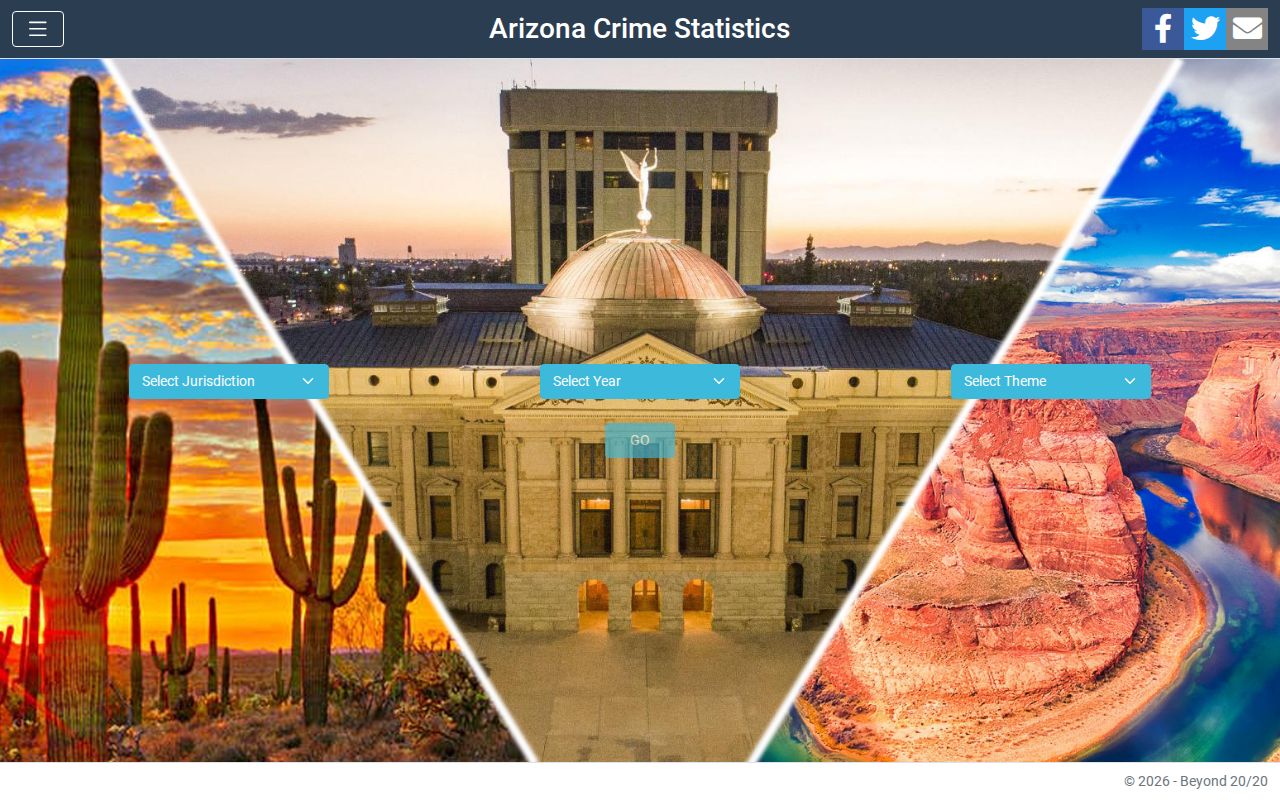
These Arizona totals count reported statistical events, not unique people and not convictions. Participating Arizona agencies supply the data, some agencies do not report full detail, and current-year results remain incomplete. NIBRS and summary reporting differences also affect comparisons. TOPS is valuable for statewide Arizona context, but it cannot locate one person's arrest record.
Note: TOPS measures reported Arizona arrest events and trends, so it cannot confirm one person's identity, custody, charge, or court outcome.
Looking Up Arrests in Arizona
A recent Arizona arrest lookup should begin where Arizona custody was created. There is no combined statewide Arizona county-jail roster. The right path depends on the Arizona arrest county, agency, and whether the person remains in local custody, has been released, or has moved into state or federal custody.
- Identify the Arizona county and arresting agency. Open the sheriff's roster first, then call the jail if spelling, release, transfer, or citation release may explain a blank result.
- Search Arizona Judicial Branch Public Access and the named Arizona Municipal, Justice, or Superior Court. Request the arrest report from its creating agency with the event date, location, report number, and person's details.
- Use ADCRR Inmate Data Search for a sentenced state prisoner, the federal BOP locator for federal custody, or VINELink for supported custody alerts.
- For one's complete fingerprint-linked Arizona record, request DPS subject review. Use a certified county disposition to challenge an error or missing court result.
The directory of all 15 Arizona counties routes to local jail and record sources. A jail roster is built to show current or recent custody. It can drop a name after release. Older Arizona arrest history may require the arresting agency's archive and the court that handled the case.
Who Holds Arizona Arrest Records
Request the Arizona record from the office that made it. Arizona DPS retains DPS-created incident, offense, collision, and related departmental reports. It does not retain every Arizona report made by a city, town, county sheriff, or other local agency. Local Arizona reports therefore go to that police department or sheriff records unit, not to the Central State Repository.
For a DPS-investigated incident, the Department Records Section accepts requests through the Public Services Portal, by mail, or in person. DPS does not accept a records request by phone. Current research lists $9 for electronic delivery up to 5 MB, $9 for the first nine paper pages and $0.10 for each later page, $15 for a DVD, and $20 for a flash drive. Video review and redaction is $21.33 per half-hour plus delivery. Qualifying victims can receive one free copy of specified material under A.R.S. § 39-127.
Arizona Public Records Law calls for prompt access to Arizona records, but it sets no one-size-fits-all completion deadline. Active Arizona investigations, juvenile or victim data, security concerns, sealing, and privacy interests can support delay or redaction. Ask for a narrow date range, event location, report number, record type, and delivery medium. Precision helps the custodian find the right Arizona arrest record.
Inside an Arizona Arrest Record
An Arizona booking entry is a custody snapshot. Published fields vary by sheriff and by the record's status. A booking photograph may be part of the jail record, but state law does not guarantee that every image is released at once. A photo proves only that a booking image was created. It does not establish guilt or the final charge.
| Name and Identifiers | Name, booking or name number, limited age or birth detail, and physical descriptors where published. |
|---|---|
| Booking Details | Booking date and time, booking agency, and intake identifier. |
| Arresting Agency | The sheriff, city police, Arizona DPS, campus, tribal, federal, or other authorized agency tied to the event. |
| Booking Charges | Provisional charge descriptions, statutes, citations, or case references recorded at intake. |
| Bond and Holds | Bond type and amount by charge, plus qualifying holds or release limits. |
| Custody Status | Housing or custody location, release date and type, or transfer information where published. |
Do not republish mugshots or treat a roster as a permanent case record. Juvenile arrest and delinquency matters do not appear in statewide Public Access and follow separate confidentiality rules. An agency blotter or news release can help with timing, but later corrections and the court disposition belong in the official sources.
Note: A published Arizona booking photograph documents intake only and does not establish that the listed allegation led to a conviction.
Arizona Arrest and Custody Systems
County jail and state prison searches cover different stages. County sheriffs operate local jails for pretrial custody, people awaiting transfer, and qualifying local sentences. The Arizona Department of Corrections, Rehabilitation & Reentry manages the sentenced state-prison system. Federal custody sits outside both. A person can also move between systems, so the last known arrest place may not be the current location.
The official representative county roster below shows the kind of current-custody list that must be checked at the local level.
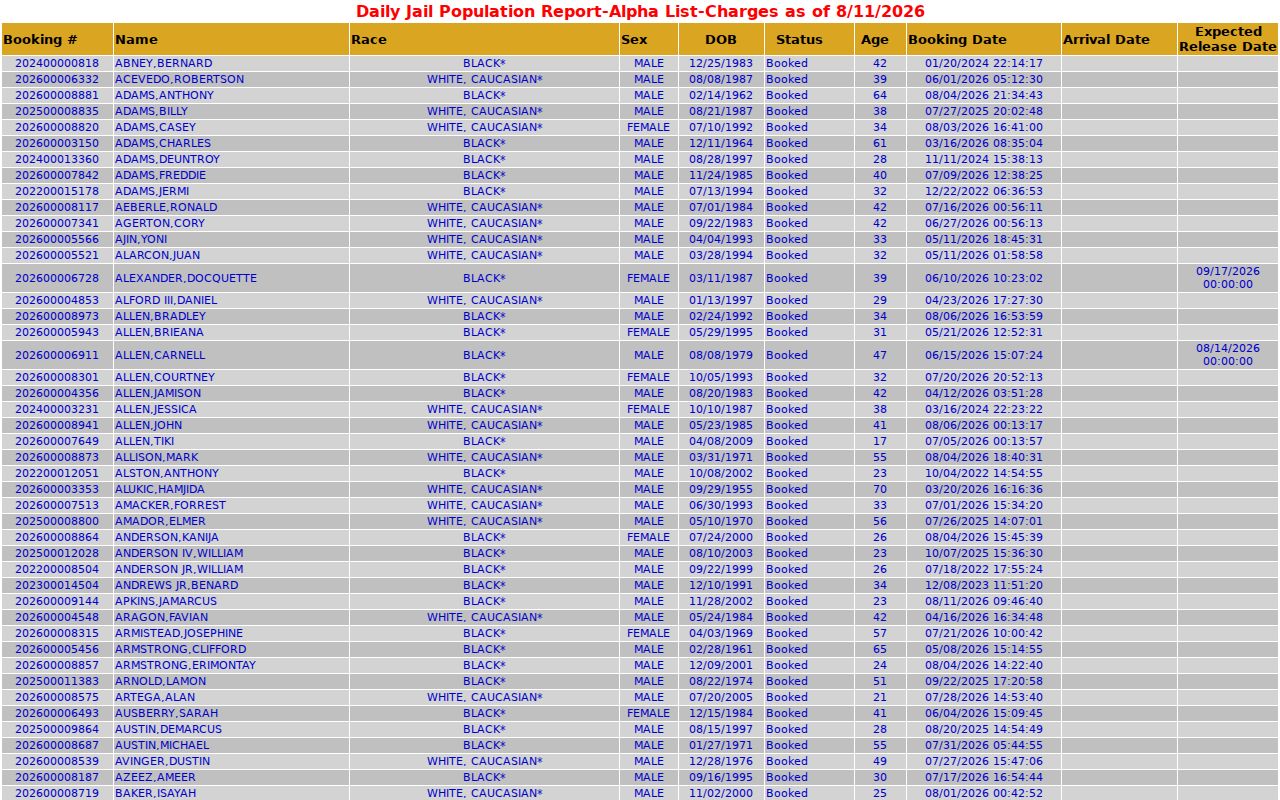
This image illustrates a county list, not statewide Arizona arrest history. The record can disappear after release or transfer, and booking fields still need comparison with the court case.
| Custody Need | Official Search | Main Limit |
|---|---|---|
| Recent or pretrial county custody | County sheriff roster or jail phone | No single Arizona county-jail database |
| Sentenced state prisoner | ADCRR Inmate Data Search | Not a county booking search; court verifies offense details |
| Federal prisoner | Federal BOP Inmate Locator | Does not cover county jail or ADCRR custody |
| Supported custody notification | VINELink | Coverage and events depend on participating systems |
ADCRR profiles can include an ADC number, status, location, commitment county, sentence, offense, and release or community-supervision dates. Those fields describe corrections custody. They do not replace the arrest report or certified court judgment.
Arrests vs Convictions in Arizona
An arrest is an accusation event supported by the legal standard required for custody. A conviction is a court judgment after a guilty or no-contest plea or a guilty verdict. Prosecutor screening can change the count after booking. A court can dismiss a charge or enter an acquittal. Each count may have its own result, so a single case status does not tell the whole story.
| Point | Arizona Arrest Record | Arizona Conviction Record |
|---|---|---|
| Created by | Arresting agency and booking jail | Court judgment, later reported to DPS |
| What it shows | An arrest and the provisional allegations at that stage | Guilt established on the specific count by plea or verdict |
| Best verification | Agency report and jail record | Filed court charge, disposition, and judgment |
| Public access | Depends on the creating custodian, record status, and legal limits | Public court file unless sealed or otherwise restricted |
| Relief | Qualifying records may be sealed under § 13-911 | Sealing, set-aside, or marijuana expungement has remedy-specific rules |
Note: An Arizona arrest entry without a disposition is not proof of guilt; verify each count with the court that handled it.
The Arizona criminal court case search is the next step after locating a booking. Capture the jail's case or citation number when available, then read the filed charge and disposition rather than relying on the intake label.
Arizona Arrest Sealing Choices
Arizona has three distinct record-relief tools. They should not be treated as synonyms. A.R.S. § 13-911 allows a qualifying person to petition to seal arrest, conviction, and sentencing records. The filing belongs in the court that handled the case. If no charge was filed, the statute and court forms direct the applicant to the appropriate court tied to the arrest.
- Sealing
- Restricts ordinary public access to qualifying arrest, conviction, and sentencing records while preserving statutory official access.
- Set-aside
- Relief under A.R.S. § 13-905 that annotates a judgment and releases specified penalties, but does not seal the court file.
- Marijuana expungement
- A separate remedy under A.R.S. § 36-2862 for qualifying conduct covered by that law.
A valid order may take time to reach every Arizona system. Check the county clerk first. Then obtain one's DPS subject review. If the fingerprint-linked repository still reports the result incorrectly, send the court order and supporting disposition through the DPS challenge process. A current jail roster, historical agency report, court file, and repository cycle may each respond to relief on a different schedule.
Note: Confirm the effect of Arizona record relief with the filing court before assuming every public or official system has updated.