
Criminal Court Cases in Arizona
Arizona divides criminal case work among Municipal or Magistrate Courts, Justice Courts, the Superior Court, and two appellate levels. Arizona city courts hear city-code offenses, misdemeanors, and criminal traffic within their jurisdiction. Arizona Justice Courts also handle misdemeanors and traffic cases, along with initial appearances and preliminary felony proceedings. Felony trials belong in the Superior Court of Arizona. The Arizona Constitution creates one Superior Court, but it operates through a division in each of Arizona's 15 counties.
That design matters when seeking an Arizona criminal court record. The statewide Arizona Judicial Branch can index a case, but it does not become the legal custodian of every filing. An Arizona city clerk holds its Municipal Court record. A Justice Court clerk holds that Arizona court's record. The county Clerk of Superior Court holds the official Arizona felony file. Appeals from the Superior Court generally move to the Arizona Court of Appeals, with further review available in the Arizona Supreme Court under the rules that govern the case.
Note: A statewide search result is a useful lead, while the clerk of the court shown on the docket supplies the official record.
Arizona Courts by Jurisdiction
The charge level and filing court control where an Arizona court case can be found. An early booking charge is not enough to choose the Arizona court because a prosecutor may amend, replace, or decline it. Citation papers, release papers, and the Arizona case number are better routing clues. The Arizona Judicial Branch court locator identifies the state's courts and helps separate Arizona limited-jurisdiction matters from Superior Court files.
| Court Level | Typical Criminal Work | Official Record Route |
|---|---|---|
| Municipal or Magistrate | City violations, misdemeanors, criminal traffic, and city warrants | City court clerk |
| Justice Court | Misdemeanors, criminal traffic, initial appearances, preliminary felony work, and warrants | Justice Court clerk |
| Superior Court | Felony trials, indictments, judgments, sentences, and some appeals | County Clerk of Superior Court |
| Appellate Courts | Review of qualifying Superior Court decisions | Appellate or Supreme Court clerk |
A single Arizona court case can touch more than one level. An Arizona felony may begin with an initial appearance in a limited-jurisdiction court, then proceed through indictment or information in Superior Court. An Arizona appeal creates a higher-court docket without replacing the trial file.
Searching Arizona Judicial Branch Public Access to Court Information
Arizona Judicial Branch Public Access to Court Information is the broad first search. It currently receives data from 177 of 184 courts. It is free, but it does not contain every case or charge. Local ordinance cases, juvenile incorrigible or delinquency cases, sealed matters, protection-order matters, and other restricted categories are excluded. Updates run each Friday through the preceding Wednesday, so a new filing can exist at court before the index reflects it.
The official Public Access screen shows the CAPTCHA and participation warnings before a search begins.
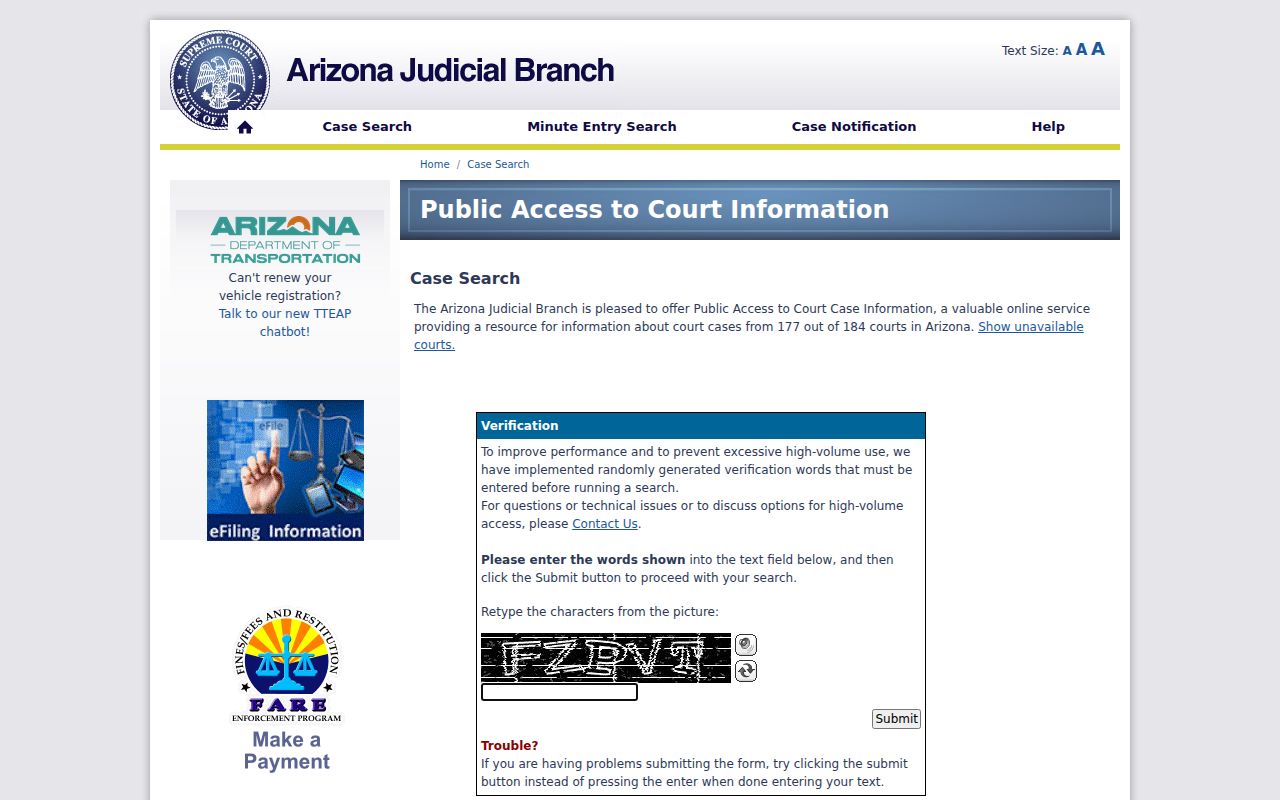
The warning is part of the Arizona search process: a result must be checked against the Arizona court of record, and an empty search is not proof that no Arizona criminal case exists.
- Identify the likely Arizona court level and county from the citation, booking paper, or known event.
- Clear the CAPTCHA, then search by exact case number when available or by party name and careful identity filters.
- Record the full Arizona case number, court, county, filing date, and case status before opening another system.
- Use eAccess for eligible Arizona Superior Court documents or the named local court portal for limited-jurisdiction records.
- Request older, certified, archived, or non-imaged material from the Arizona clerk that owns the official court file.
| Field Label | Type | Required | Search Note |
|---|---|---|---|
| Last or Business Name | Text | Yes in name mode | Try verified legal spelling and known variants |
| First Name | Text | No | Helps narrow common surnames |
| Birth Month and Year | Dropdowns | No | Use only when the identity detail is reliable |
| Court | Dropdown | No | Defaults to all searchable courts |
| Case Prefix and Number | Text fields | Yes in case mode | Separates a prefix such as CR or TR from its number |
| Vehicle Hold | Checkbox | No | Limits results to cases with that hold |
Arizona eAccess Coverage Dates
Public Access finds an index entry. Arizona eAccess goes further for unrestricted Superior Court case data and document images. Criminal coverage begins July 1, 2010, except Pima County criminal cases begin July 1, 2015. The account system supports case and party searches, individual document purchases, subscriptions, and electronic certification. Sealed and otherwise restricted documents remain unavailable.
The official eAccess landing page shows the separate document portal used after a statewide court case has been identified.
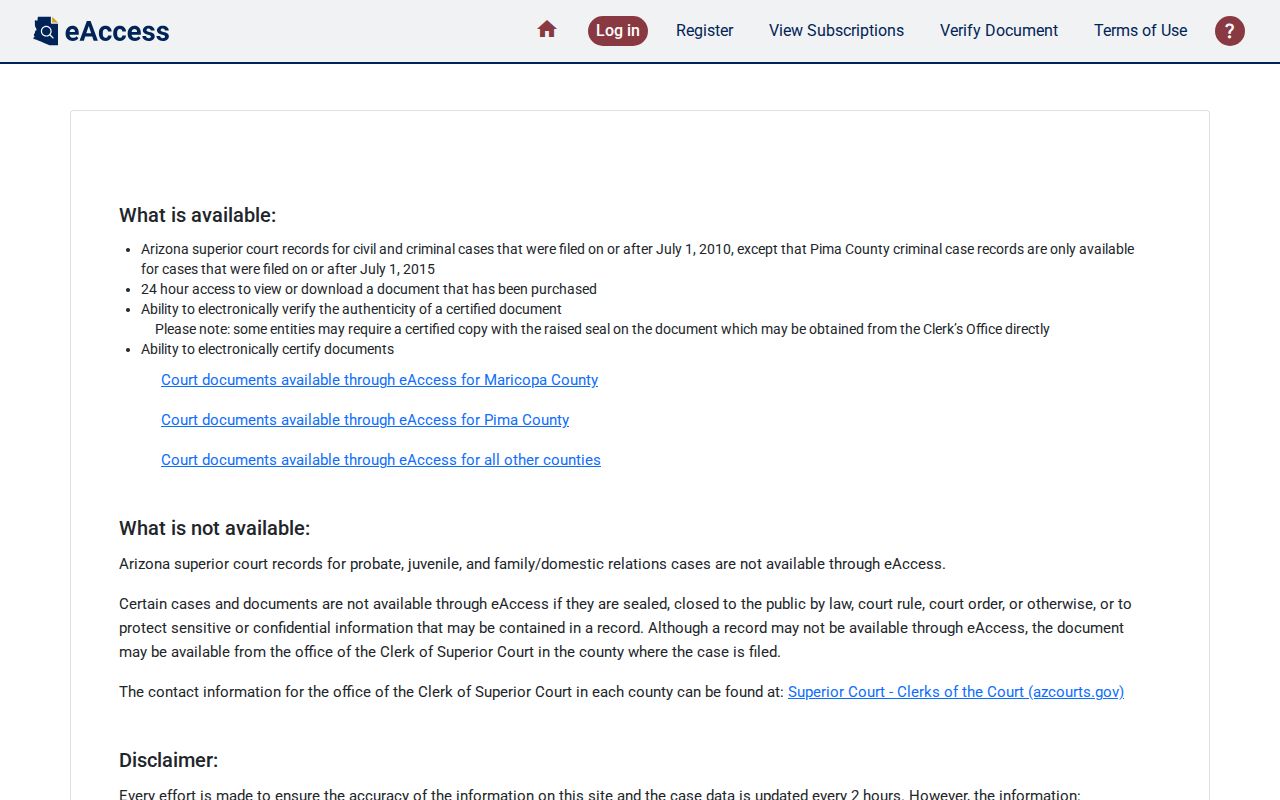
Arizona eAccess results can be searched with a case number, party, court, filing-date range, judicial officer, or criminal case type. Results may show Arizona case, party, charge, event, and hearing areas. They cap at 1,000 entries and can be exported after CAPTCHA. A purchased file must be viewed or downloaded within 24 hours. Its first-page preview is marked unofficial, and a person who needs an Arizona raised-seal certification must still ask the county clerk.
Note: Arizona eAccess document fees and certification charges are separate from free Public Access searches and from local clerk copy charges.
Inside an Arizona Criminal Case File
An Arizona criminal case file records what the prosecutor filed and what the Arizona court did. It can resolve questions that an Arizona jail booking or rap sheet cannot. Read the Arizona file charge by charge. One count may end in conviction while another is dismissed. A blank disposition field means none was entered in that view, not that the charge was dismissed.
| Case Number and Court | Identifies the legal file, the county or city court, filing date, assigned judicial officer, and case status. |
|---|---|
| Charging Documents | Shows the complaint, information, or indictment and the statutes and classifications actually filed. |
| Parties and Counsel | Lists unrestricted party and attorney information while protected identities remain redacted. |
| Docket and Events | Tracks minute entries, motions, hearings, warrants, filed documents, and event dates. |
| Disposition | Records the result on each count, such as plea, verdict, dismissal, or acquittal. |
| Judgment and Sentence | Shows incarceration, probation, restitution, fines, conditions, and later qualifying orders. |
Victim identities, Social Security numbers, juvenile information, sealed documents, and other sensitive data may be excluded from an Arizona case. Arizona Supreme Court Rule 123 governs judicial record access. Executive-branch public-record rules do not override an Arizona court restriction.
When Arizona Case Search Misses
A missing Arizona court case may reflect coverage, timing, or the wrong court, not the absence of a case. Start with the official unavailable-courts list. Public Access omits all local ordinance charges and receives partial or delinquent data from some systems. A very recent court case can also fall inside the weekly update gap. Older cases may be archived, and eligible sealed records should not appear in an ordinary public search.
Check the local Arizona court next. The official screenshot below comes from a representative Justice Court portal and demonstrates why limited-jurisdiction records often require an Arizona county or city search after the statewide pass.
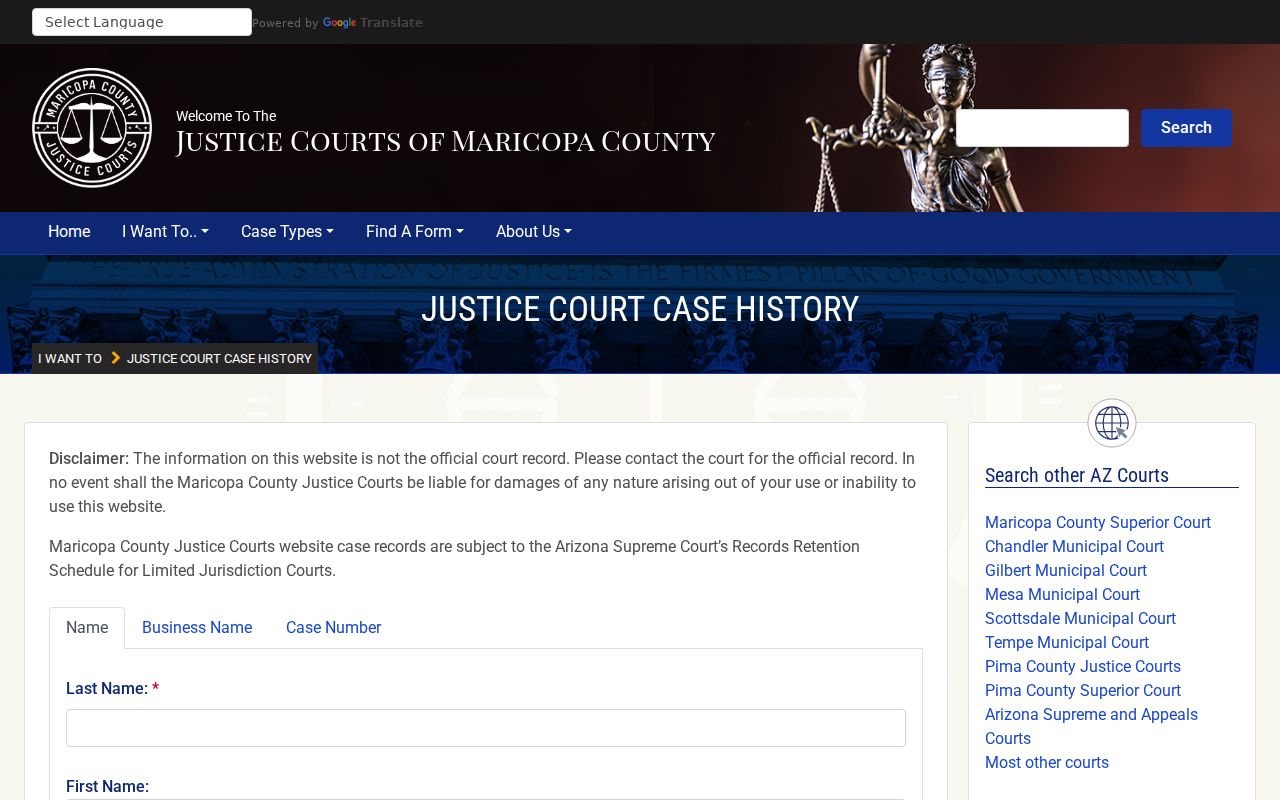
The local Arizona index is still informational. Use its court and case number to ask the Arizona clerk for the official docket or document. For a recent arrest, also allow time for prosecutor screening. The Arizona booking allegation can change before any complaint, information, or indictment is filed.
How an Arizona Criminal Case Moves
An Arizona court record grows in stages. An arrest or citation may lead to an initial appearance. If a person was arrested, the Judicial Branch states that the initial appearance must occur within 24 hours or the person must be released. The judicial officer confirms identity, explains the charge and rights, addresses counsel, assesses probable cause for release purposes, and sets release conditions.
The prosecutor then screens the matter. A complaint, information, or grand-jury indictment may replace the officer's first charge. Arraignment records the plea. Disclosure, motions, and pretrial conferences add docket events. A plea agreement or trial leads toward judgment. Sentencing can impose jail, prison, probation, restitution, fines, or conditions. Appeal and post-conviction work may add later filings.
Case flow: Charges Filed › Arraignment › Pretrial › Plea or Trial › Disposition › Sentencing
Note: An Arizona booking charge can change at prosecutor screening, so the filed count and final disposition deserve separate review.
Reading Arizona Court Dispositions
Short docket labels can hide a major difference in outcome. “Pending” means no final outcome has been reported. “Disposed” means the court entered some outcome, but it does not say every count ended the same way. Read each charge and the judgment. The following terms help decode an Arizona criminal court file without treating an accusation as a finding of guilt.
- Complaint
- A sworn charging paper often used to begin a criminal or limited-jurisdiction case.
- Information
- A felony charging document filed by the prosecutor after the required process.
- Indictment
- A felony charging document returned by a grand jury after a probable-cause decision.
- Disposition
- The result of one charge, which may be conviction, dismissal, acquittal, or another recorded outcome.
- Set-aside
- Relief under A.R.S. § 13-905 that annotates a judgment but does not seal or erase the public court file.
A sealed case is different. A.R.S. § 13-911 permits qualifying people to seek sealing of arrest, conviction, and sentencing records. Restricted access after a valid order does not mean the underlying official record never existed.
Arizona Court Records and DPS
An Arizona county court file and the Arizona DPS repository answer different questions. An Arizona court file gives pleadings, minute entries, events, documents, and a charge-level result from one legal case. The Arizona Central State Repository compiles fingerprint-linked arrest cycles and reported dispositions from across Arizona. It is a rap sheet, not a substitute for the underlying docket, and Arizona does not offer the public a pay-per-name repository search.
If a person's own Arizona DPS review shows an open or incorrect cycle, obtain the certified disposition from the clerk. That court proof supports a challenge to DPS. If the online docket conflicts with a jail roster, remember that the roster shows custody and provisional booking charges. The filed court count and final order control the case outcome. A separate Arizona arrest lookup can help identify the arresting agency and booking source before the court search begins.
Case Records at the County Level
The complete Arizona criminal case file stays with the Arizona clerk where it was filed. Superior Court felony documents route to the county Clerk of Superior Court. Arizona Justice and Municipal Court documents route to their own clerks. Arizona county and city portals may offer a free index, while copies, research, document delivery, and certification can carry charges under the current state or local schedule. Arizona's statewide fee schedules may not include every local addition.
Use the Arizona County Directory to reach the correct local criminal-record site. Bring the exact case number, party name, approximate year, court name, and document title. Ask for the indictment or information, dismissal, plea, judgment, or sentence rather than requesting an undefined “criminal record.” A focused request helps the clerk find the right public item and apply any redaction or access rule correctly.
Note: Certified Arizona court dispositions come from the clerk that holds the case, not from the statewide informational index.