
What the Arizona Department of Public Safety Is
The Arizona Department of Public Safety, Criminal Justice Services Bureau, Central State Repository Section is the state’s official criminal-history repository. A.R.S. § 41-1750 gives DPS that role and requires criminal justice agencies to report qualifying arrests and final dispositions. The repository links events through fingerprints rather than relying only on names.
Arizona DPS does not offer ordinary residents a pay-per-name statewide rap-sheet search on another person. Its public-facing repository service centers on a subject reviewing their own fingerprint-linked record. Public research about another person uses separate systems, such as Arizona court indexes, county clerks, jail rosters, police records, the state prison locator, and the public registry. Each answers a different question.
Inside the bureau, the Central State Repository works alongside ACJIS access and integrity, Uniform Crime Reporting, applicant processing, biometrics, and sex-offender compliance. The Clearance Card Section is a separate function within Arizona DPS. A clearance card is a suitability credential for a legally authorized category, not a copy of the holder’s rap sheet.
Arizona DPS Records by the Numbers
The Criminal Justice Services Bureau reports more than 3 million active criminal histories and more than 2.7 million criminal-history requests each year. Arizona DPS also reports about 70,000 active warrants in its systems. These figures describe records and transactions. They do not count convictions or unique people in a single year.
The biometric side is larger because it supports many identification functions. DPS reports 7.8 million fingerprint records, 12.9 million mug images, and 250 Livescan devices. The Biometrics Technology Section can store palm prints, iris records, MVD and booking images, tattoos, and latent prints for authorized identification work. Those restricted holdings are not fields promised in a public subject-review response.
Access is narrower than scale. Arizona DPS may hold millions of fingerprint-supported records while still lacking authority to sell the public a statewide name search.
Arizona DPS Criminal History Check Options
Arizona DPS separates products by requester, legal authority, and output. The subject review returns a person’s own Arizona repository record for accuracy and completeness. An authorized agency transaction sends fingerprint results to the agency permitted to receive them. A Fingerprint Clearance Card results in a card or denial, not disclosure of the underlying history to the public.
| Product | Who May Order | What It Returns | Cost or Timing |
|---|---|---|---|
| Subject Record Review | The person whose record is reviewed | Any Arizona repository history for self-review and challenge | Free from DPS; outside fingerprint fee may apply; complete mail packet answered within 15 days |
| Record Challenge | The subject disputing their own record | Source verification and correction when supported | No DPS challenge fee located; timing depends on the source agency |
| Authorized Fingerprint Check | An agency with approved legal authority | State-only or state and FBI result sent to that agency | $5 state-only; $22 regular state/FBI; $20 qualifying volunteer, June 2025 schedule |
| Fingerprint Clearance Card | An individual in an Arizona statutory category | Six-year suitability card or denial, not a public rap sheet | $67 regular; $65 qualifying volunteer; $5 replacement, plus possible capture fee |
| DPS Department Record Request | Any requester, subject to disclosure law | DPS-created reports or media, not a statewide rap sheet | Item and redaction dependent |
Why Arizona DPS Has No Public Name Search
Arizona repository information is not governed by the same access rule as a public court docket. A.R.S. § 41-1750 controls repository dissemination and does not give DPS authority to sell private citizens a criminal-history check on someone else. A broad request for “criminal history” can therefore receive a lawful denial even when separate public court or police records exist.
The right channel follows the record’s custodian. Arizona Public Access can identify cases in participating courts. eAccess can provide unrestricted Superior Court documents within its coverage. County clerks supply official case files and certified dispositions. A sheriff owns its jail and booking records, while an arresting agency owns the incident narrative. The Arizona Public Records Law applies to many agency records, but it does not override the repository’s specific restrictions.
Unauthorized access, use, or release of protected criminal-history information can carry consequences under A.R.S. § 41-1756. Public access should never be confused with access to ACJIS or restricted repository data.
How Records Reach Arizona DPS
A reportable Arizona arrest begins with a police agency, county sheriff, DPS unit, or other authorized agency. At booking, ten-print fingerprints and a process-control transaction connect the event to a biometric identity. Prosecutors report termination decisions. Courts report formal dispositions. DPS then links the later result to the arrest cycle in Arizona Computerized Criminal History.
Data flow: County Arrest › Fingerprint Submission › Arizona Department of Public Safety › Court Disposition Reporting › Rap Sheet
The reporting stages have different deadlines under § 41-1750. The fingerprinting agency generally sends prints within ten days. A defendant ordered to complete missing prints at an initial appearance or arraignment may have 20 calendar days. Prosecutor termination reports and formal court or corrections dispositions generally carry 40-day reporting rules.
Different offices handle those transactions. An arrest can reach Arizona DPS before a prosecutor changes or declines a charge. A disposition can arrive late, carry a bad link, or lack the correct process-control number. The county court remains the best source for the final judgment. The rap sheet is a compiled state summary, not the original case file.
Arizona DPS Uses ADRS and ACCH
The Arizona Disposition Reporting System is a restricted workflow for law enforcement, courts, and prosecutors. ADRS exchanges updates with Arizona Computerized Criminal History in real time. Its documented coverage applies to arrests dated on or after February 1, 2007. Public users cannot enter ADRS or use it as a search portal.
Arizona DPS states that final disposition data is purged from the ADRS work system 31 days after the last charge update. That does not mean the criminal-history result vanishes from ACCH. The systems serve different roles. ADRS is the disposition work queue. ACCH is the governed criminal-history repository.
A missing outcome can result from an incomplete print card, a name variation, a delayed county interface, or a disposition that did not match its arrest cycle. Arizona DPS publishes no statewide disposition-completeness percentage. The practical test is to compare the subject review with the court’s certified disposition.
Ordering a Check From Arizona DPS
A resident reviewing their own record can start online in the Arizona DPS Public Services Portal or use the mail Record Review Packet. The packet includes instructions, a blank applicant fingerprint card, a contact sheet, a checklist, and a return envelope. DPS does not take public fingerprints, so the applicant uses a law-enforcement agency or professional printer.
The Arizona DPS Public Services Portal login is the online doorway for a subject record review and other public services.
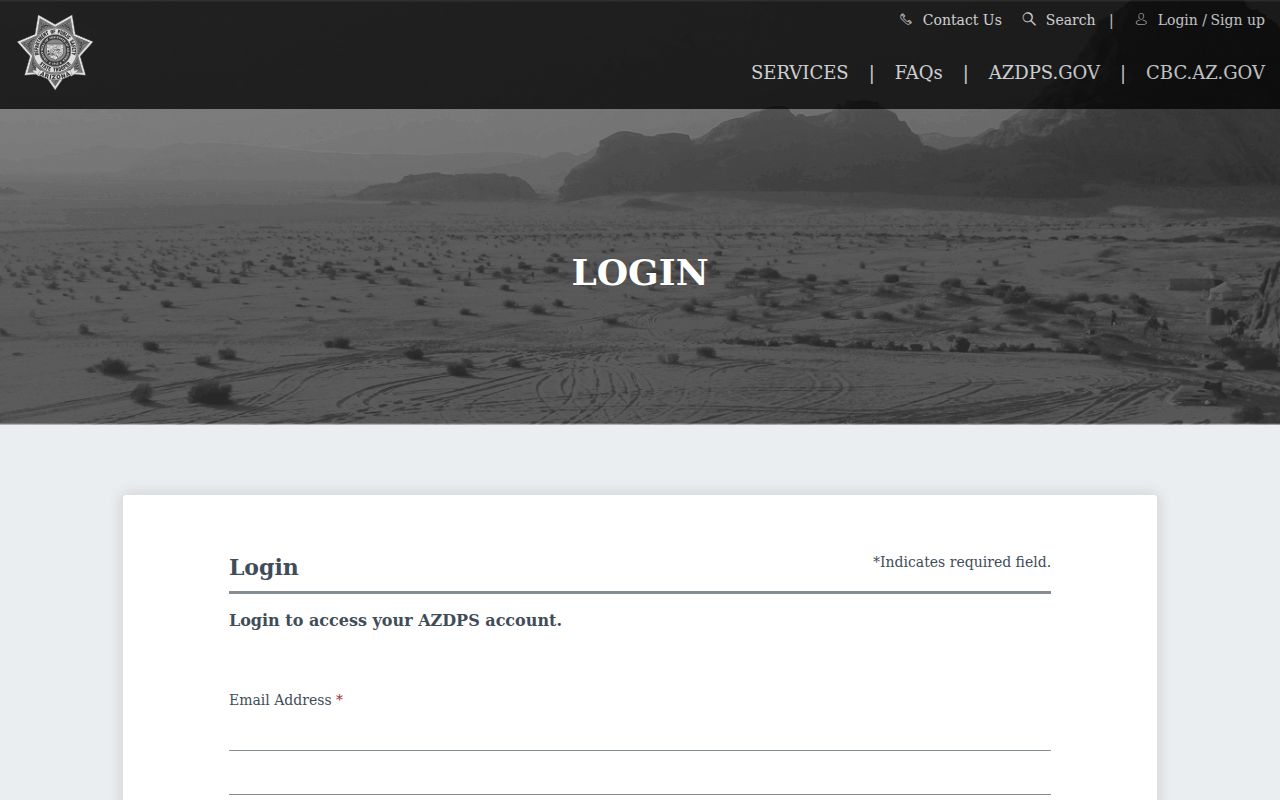
The portal screen requires an account before protected self-review steps begin. Email, password, account creation, and password recovery appear at login, while the criminal record itself remains behind the verified workflow.
- Choose the subject Record Review, not an authorized agency transaction or clearance card.
- Create or sign into PSP, or obtain the complete mail packet.
- Have fingerprints placed on the required card by a qualified outside printer.
- Submit all contact, card, printer-certification, and checklist items through the stated channel.
- Read each arrest cycle and disposition, then compare any disputed entry with the originating county file.
Arizona DPS and FieldPrint
FieldPrint is the electronic capture network for Arizona clearance-card and authorized applicant submissions. It is not the subject Record Review itself, and it does not turn the repository into a public name search. For an electronic authorized transaction, PSP issues a reference beginning with “A.” The user then enters that reference, last name, and date of birth in FieldPrint and chooses an available site and time.
The reference, identity data, and presented identification must match. A mismatch can produce a “Problem with Request” response. Arizona DPS directs correction requests to its Applicant Processing Team with the reference, ID image, and explanation. FieldPrint transmits the prints to DPS. No paid expedited Applicant Processing Team option is listed.
Beginning in January 2026, Arizona DPS accepts only the current Non-IVP paper application. A paper fingerprint card requires the technician-completed affidavit sealed with the card. Electronic submissions use FieldPrint. IVP and Non-IVP describe identity-verification routes, not different criminal databases.
Arizona DPS Fingerprint Fees
The Arizona DPS Applicant Processing Team page distinguishes current fingerprint products and links the dated fee schedule.
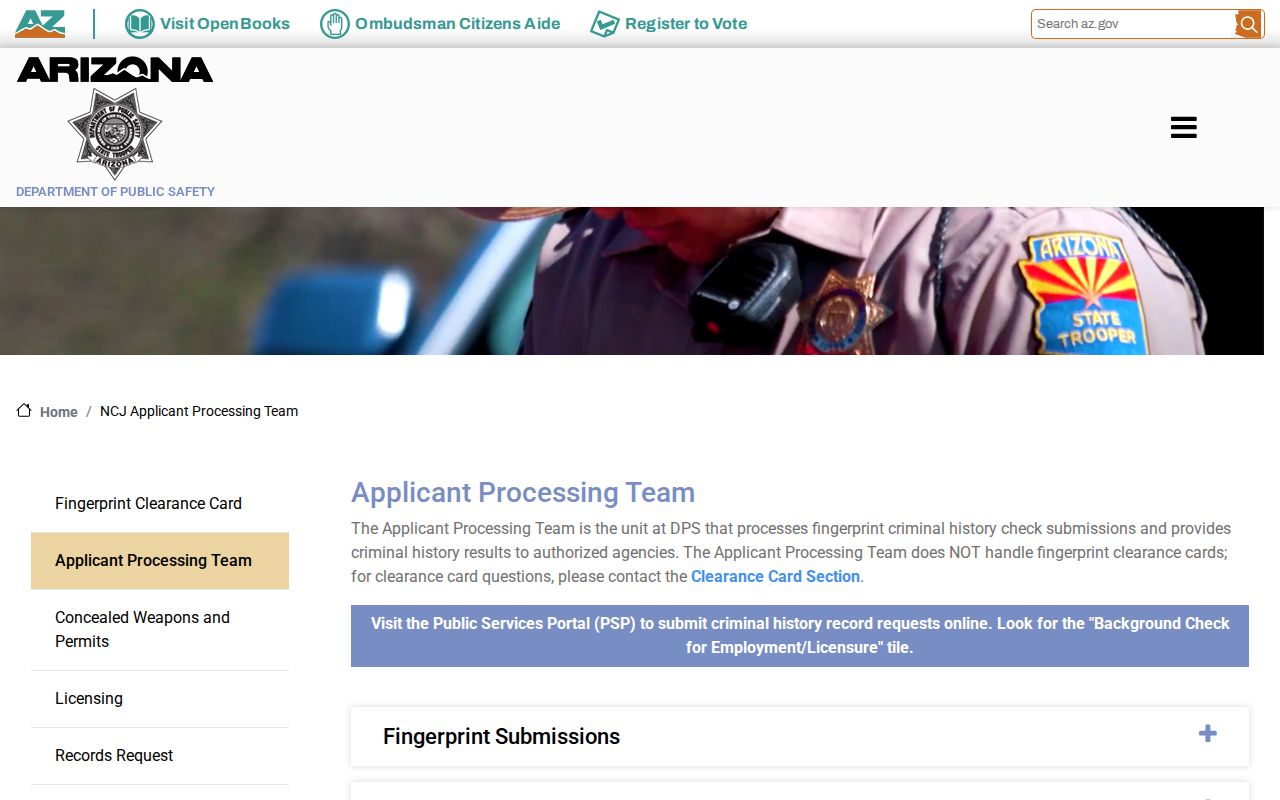
The schedule separates the $22 regular state and FBI transaction, $20 qualifying volunteer transaction, and $5 Arizona-state-only transaction as of June 2025. Capture or service fees charged by the outside printer are separate. Processing fees are generally not refunded simply because a transaction produces no useful record or a card is denied.
Fees answer only part of the question. The person’s own DPS Record Review remains free from DPS, although fingerprinting can cost extra. County clerk copies, certification, and court research use separate schedules. A person should identify the needed output before paying for a fingerprint service.
County Records vs Arizona DPS Checks
An Arizona DPS subject review follows fingerprint-linked arrest cycles across the state. A county court file follows one legal case in detail. Neither replaces the other. The repository can connect events across counties, but a clerk file is more likely to contain the complaint or indictment, minute entries, plea, dismissal, judgment, sentence, and certification needed for a correction.
| Question | Arizona DPS Review | County Record |
|---|---|---|
| Coverage | Reported fingerprint-linked Arizona cycles | One court, jail, police agency, or county system |
| Source | Compiled ACCH repository entry | Original docket, report, or booking record |
| Freshness | Depends on contribution and matching | Often changes as the local case proceeds |
| Detail | Identity, arrest, charge, and available disposition summary | Filed documents, events, narrative, custody, or certified result |
| Best Use | Reviewing one’s statewide Arizona record | Verifying the event and proving the final outcome |
Start with the repository when reviewing your statewide file. Use the Arizona county directory when an entry needs the source document, a newer docket status, or correction by the office that created it.
Arizona DPS Records System History
Arizona’s identification work predates modern DPS. A 1929 law created a Bureau of Criminal Identification to index fingerprints, photographs, measurements, and descriptions for law enforcement. The records moved under the State Prison superintendent in 1956. Laws enacted in 1968 created DPS, and modern Arizona DPS began in 1969 after state enforcement functions were consolidated.
Automated Biometric Identification System became active in 1995. The Clearance Card Section followed in 1998. In 2022, Arizona DPS moved ABIS to cloud infrastructure. These milestones track a shift from paper fingerprint and arrest cards to a statewide biometric system that exchanges data with authorized criminal justice users.
Modern access remains intentionally split. Public court portals provide public case information. PSP gives a record subject an online review route. ADRS serves justice agencies. ACCH holds governed repository history. Understanding that split prevents a common error: assuming a modern login page made the state rap sheet open for searches on other people.
Arizona DPS Clearance Cards Differ
A Fingerprint Clearance Card is not a criminal-history report. The applicant selects an Arizona statutory authority, submits fingerprints, and receives a DPS card or denial after review of legally defined factors. The card remains valid for six years. Regular and Level I cards correspond to different statutory categories and precluding factors.
The Arizona DPS Fingerprint Clearance Card page sets out the application route, fees, validity, retention notice, and status resources.
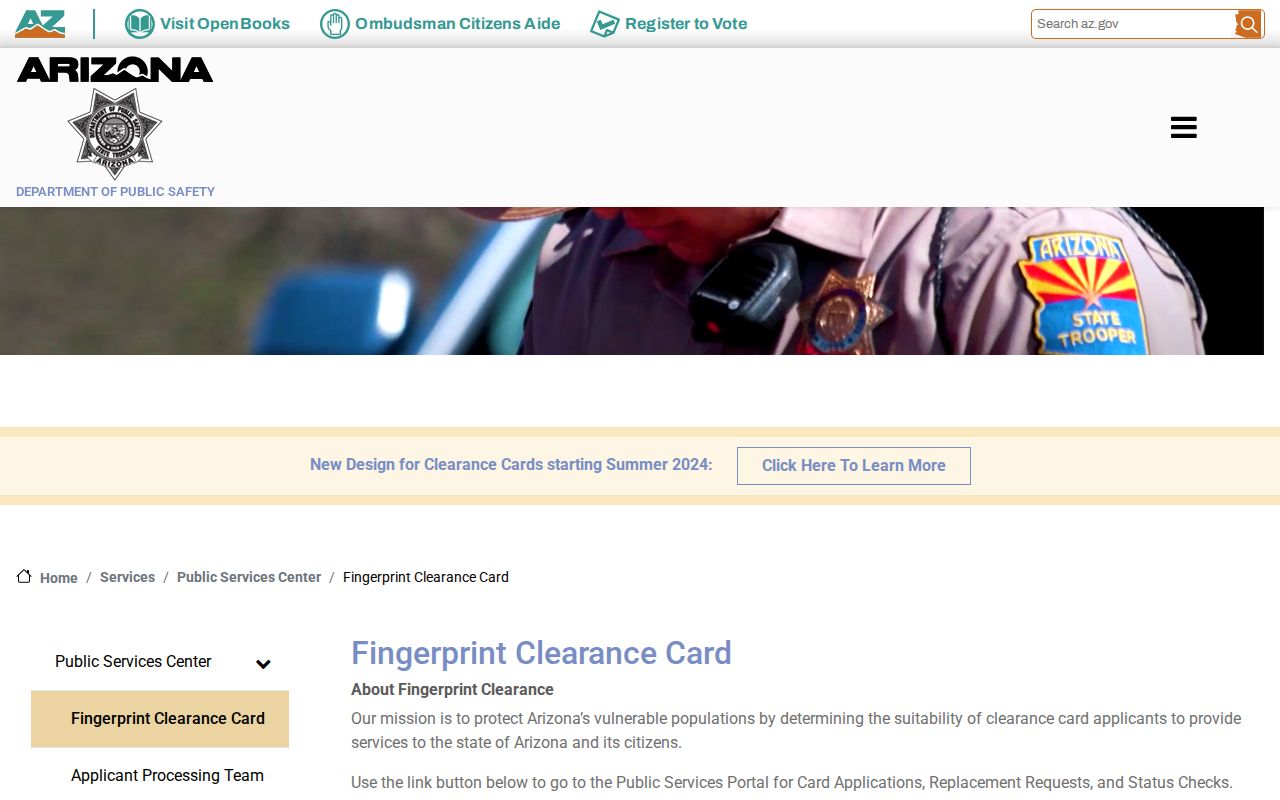
The official page makes the product distinction visible. A clearance card reports suitability status. An authorized fingerprint transaction reports results to an authorized agency. A subject Record Review gives the person their own Arizona repository record and a correction path.
Arizona DPS and the FBI may retain submitted fingerprints and compare them with later submissions, including latent prints. Anyone who believes a fingerprint-derived Arizona result is incomplete should use the self-review process rather than trying to obtain an authorized agency’s confidential response.
Fixing Errors in an Arizona DPS Record
Common problems include a missing dismissal, a disposition attached to the wrong arrest cycle, a charge that looks open after the court entered a result, or a sealing order that has not propagated. Arizona DPS must verify against the contributing source. It cannot rewrite a court judgment or police record based only on a requester’s statement.
- Request your own fingerprint-based Arizona DPS Record Review through PSP or the mail packet.
- Match each disputed arrest and disposition to the official county court or source-agency record.
- Obtain a certified disposition, correction, or sealing order when the source record supports the change.
- Follow the DPS challenge instructions, identify the exact cycle or field, then request a fresh review after the source and repository finish their work.
DPS states that it mails a response within 15 days after receiving a complete Record Review Packet. Challenge timing varies because DPS may need the court, prosecutor, booking agency, or another contributor to verify the source. If the county file itself is wrong, correct that record before asking the repository to mirror it.
Note: A certified county disposition is often the strongest support when an Arizona DPS arrest cycle lacks its final court outcome.