
Running a Sex Offender Check in Arizona
The official public route is the Arizona Sex Offender Registry in OffenderWatch. It supports name and place-based queries across Arizona. The registry is a notification record, not a complete criminal history. A result can help a family understand a nearby published registration, identify the responsible registering agency, or locate the jurisdiction tied to an offense. It does not replace the conviction file, a current custody check, or an emergency call.
Arizona DPS maintains the statewide system through its Sex Offender Compliance Unit. County sheriffs create and update the local registration record. That two-part structure matters when a profile looks stale or incomplete. Search statewide first. Then use the Arizona county directory to reach the sheriff or clerk that holds the source material. For an immediate threat, contact 911 or local law enforcement rather than a registry inquiry form.
Arizona Registry Results Have Limits
Arizona does not publish every registrant on the main website. Level 2 and Level 3 records are generally public, and A.R.S. § 13-3827 adds defined offense-based publication categories. Some Level 1 records can therefore appear, while other Level 1 registrants remain outside the main search. The difference comes from Arizona publication law, not a simple three-tier duration chart.
Map results have a second limit. OffenderWatch cannot place an address it cannot map electronically. A ZIP or city boundary can also hide a nearby point from a narrow geographic query. Check the non-mappable and non-compliant lists before treating an empty map as an all-clear. A name query can match an alias even when the results display the legal name. These limits make the registry a lead that calls for careful verification.
Arizona DPS reported 16,769 people on the registry in December 2025. That total exceeds the public website population because public display and registration duty are different legal questions.
How to Search the Arizona Sex Offender Registry
Start with the narrowest facts that are reliable. A full street address is more useful for proximity than a ZIP alone. A name search works best with spelling variants and a first name, but common names require comparison against the profile photograph and physical details. The portal also separates map, list, non-compliant, and alert functions.
- Open Arizona OffenderWatch and accept its public-use terms.
- Choose a name, city, ZIP, or full-address search and enter only facts you can verify.
- Review map and list results, then check non-mappable and non-compliant records.
- Open a profile and compare the photograph, aliases, descriptors, address type, offense, and registering agency.
- Use the identified court or county sheriff when the underlying conviction or current compliance needs confirmation.
| Field or Control | Type | Required | Arizona Search Note |
|---|---|---|---|
| Address, City, State, ZIP | Text and dropdown | Yes for area search | Use a full address for the strongest proximity check. |
| ZIP Plus | Text | No | Adds a ZIP+4 extension when known. |
| Last Name, First Name | Text | Mode dependent | Partial names work; aliases may match while the legal name displays. |
| Address Type | Choice | No | Can distinguish home and secondary addresses. |
| Map and List | View controls | No | Check both views and do not invent a radius beyond offered controls. |
| Email Alerts | Signup | No | Saves a location for notice of qualifying nearby updates. |
Arizona DPS Registry Controls
The Arizona DPS Sex Offender Compliance page explains public levels, county contacts, downloads, alerts, and correct use of registry data.
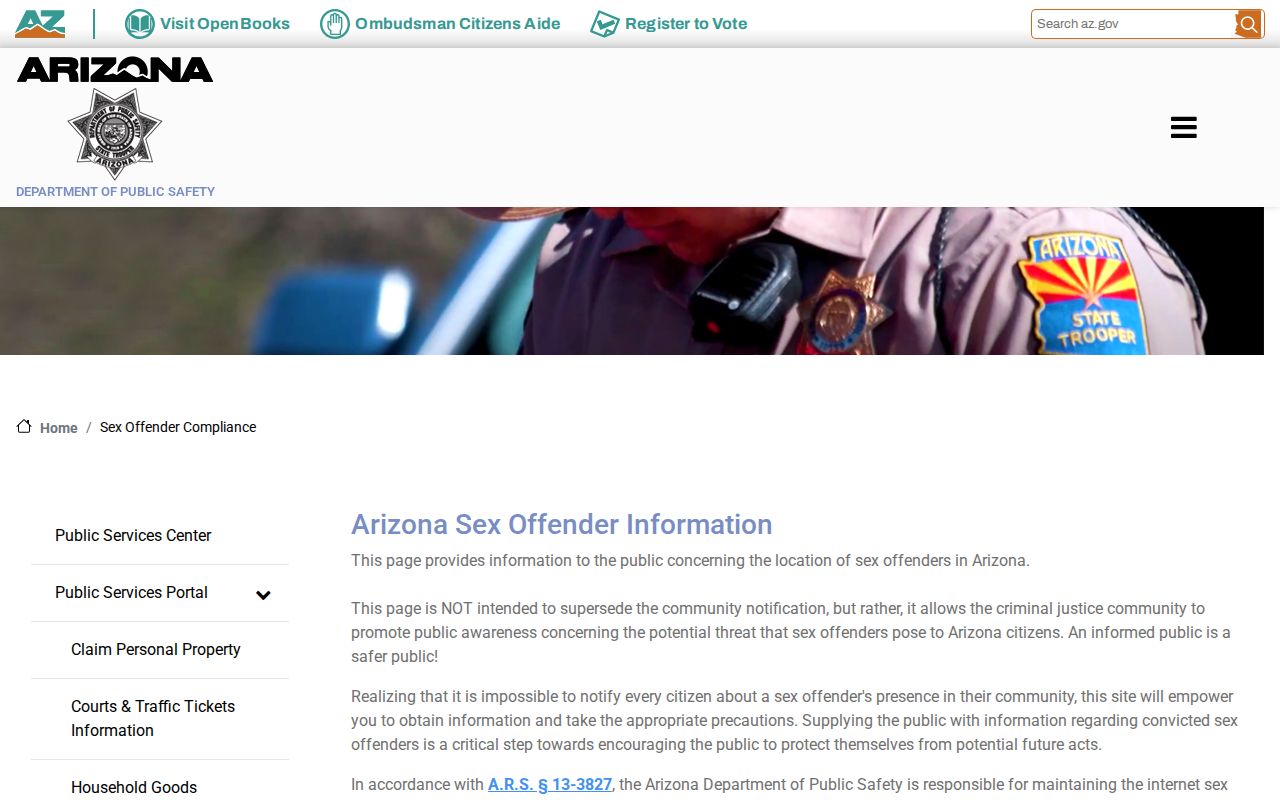
The official screen reinforces the division of work: DPS manages statewide policy and publication, while registration and recent compliance questions go to the appropriate county sheriff. The DPS general inquiry form is not a registration channel and is not the place to report an urgent incident.
Initial registration includes fingerprints, a photograph, known names, required online identifiers, vehicle and residence information, and other statutory fields. The sheriff forwards the record to DPS and, when required, local police. This flow explains why a correction often begins with the registering county rather than with the public website.
Inside an Arizona Registry Profile
A public Arizona profile provides enough detail to distinguish records and locate the source jurisdiction. It does not expose the entire registration file. The public view can omit full birth data, victim information, court documents, a sentence, sensitive identifiers, and fields kept for authorized law enforcement. Use the offense and jurisdiction fields to locate the official conviction record.
| Name and Aliases | Published legal name and contributed aliases used for matching. |
|---|---|
| Photograph and Description | Current image plus age or limited birth data, sex, race, height, weight, hair, eyes, scars, marks, or tattoos when published. |
| Registered Location | Address, address type, secondary residence, transient, unknown, or unmappable status as allowed. |
| Offense Information | Offense description, conviction jurisdiction, and related information supplied to the public view. |
| Notification Level | Arizona risk level after assessment, when completed and published. |
| Compliance and Agency | Status and the county or agency responsible for the registration record. |
A non-compliant label is a status lead. It is not proof of a new conviction and does not authorize confrontation. Report a suspected violation to law enforcement.
Arizona OffenderWatch Address Alerts
OffenderWatch offers proactive notice for a saved Arizona address. The form calls for a street address rather than a post office box, plus city, state, ZIP, email, confirmation email, and acceptance of the notification terms. The ZIP-search prompt confirms a one-mile alert radius. Other radius controls can change with the live interface, so rely on the options shown rather than a copied distance list.
An alert means that a published registry record was added or updated near the saved location. It does not report every police event, every registrant, or every Level 1 record. The system states that a confirmation message should arrive within 24 hours. A profile-level tracking action follows one public record and is distinct from an address-proximity alert.
Note: An Arizona proximity alert reports a registry update, not a prediction that an offense will occur near the saved address.
Arizona Registration Requirements and Levels
Arizona Levels 1, 2, and 3 are community-notification risk levels. They are not the federal shorthand of ten years, 25 years, and life. A 19-factor assessment produces a recommended level. Public visibility depends on the level and any separate offense-based publication rule. Registration is usually for life, but Arizona law contains specific exceptions and court-based relief.
| Level or Category | Duration | Verification and Public Notice |
|---|---|---|
| Level 1 without another trigger | Usually lifetime unless a statutory exception applies | Annual birth-month verification; generally limited public notice |
| Level 1 with a publication trigger | Level alone does not set a shorter term | Annual verification; may appear online or receive community notice |
| Level 2 | Usually lifetime unless relief applies | Annual verification plus mandatory community notice and website inclusion |
| Level 3 | Usually lifetime unless relief applies | Annual verification plus the broadest assessed community notice |
| Specified minor kidnapping or unlawful imprisonment case | Ten years in the narrow first-offense situation defined by law | Annual verification; publication depends on statute and level |
| Juvenile duty | Generally ends at age 25, subject to court authority | Verification and publication depend on the order and law |
Arizona Sheriffs Feed the Registry
A person covered by A.R.S. § 13-3821 generally registers within ten days after conviction or adjudication. A person entering an Arizona county and remaining at least 72 hours generally registers within 72 hours, excluding weekends and legal holidays. The first registration occurs with the county sheriff, not through the public search.
Annual in-person verification occurs during the birth month. Multiple residences and transient status can require reporting at least every 90 days. Moves and many name or address changes generally must be reported within 72 hours, excluding weekends and legal holidays. New online identifiers have their own prompt reporting rules. Arizona also imposes a $250 court assessment at initial registration. The public OffenderWatch search itself is free.
This county-to-state chain is important for corrections. Contact the registering sheriff first because the county retains the original record. DPS then handles the combined statewide system. Local office routes for all 15 jurisdictions appear in the Arizona county directory.
Search Beyond Arizona Borders
The National Sex Offender Public Website is the official federal starting point when a location or history crosses state, tribal, or territorial lines.
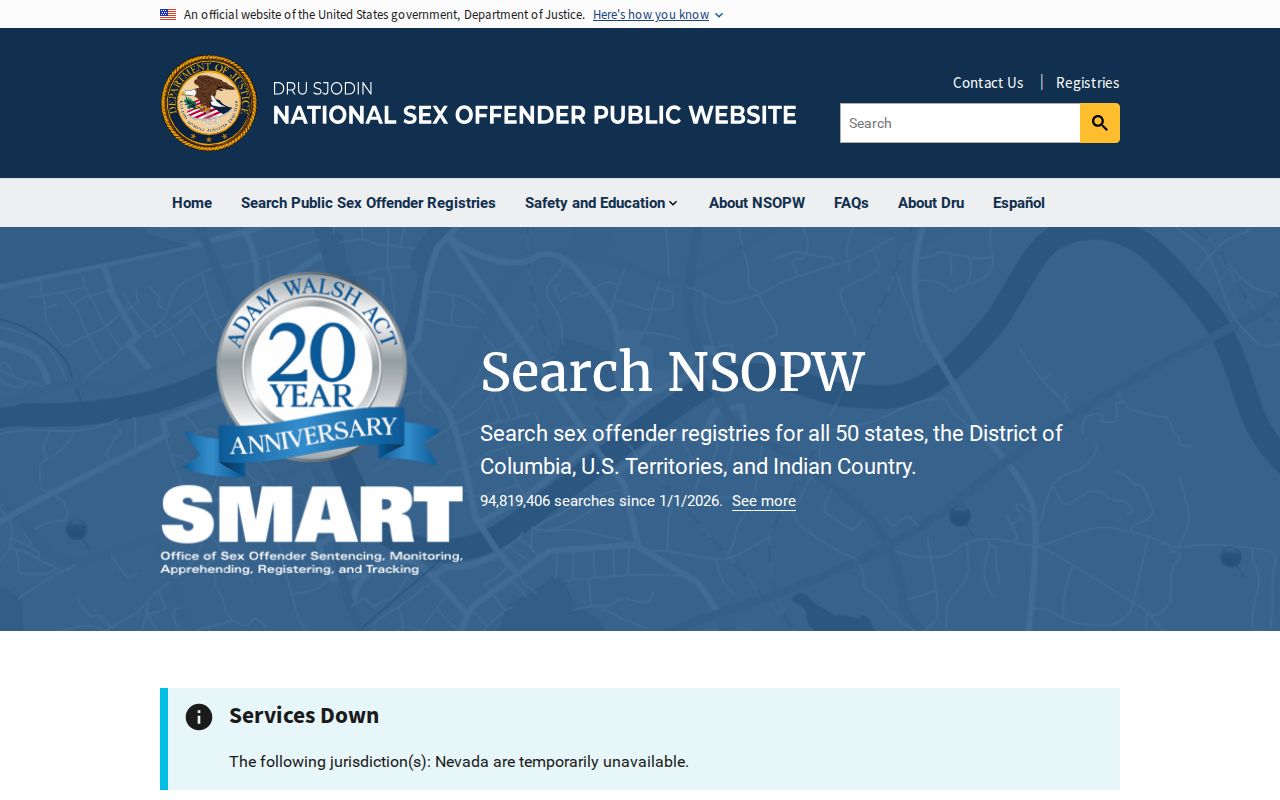
NSOPW federates records from participating jurisdictions. It does not replace Arizona rules for level, publication, duration, or county verification. Return to Arizona OffenderWatch for the Arizona profile and to the identified county for the source registration or court file.
That distinction also helps when someone recently moved. A record can follow different publication rules on each side of a state line. Check both the national result and the current jurisdiction rather than assuming Arizona labels carry the same meaning elsewhere.
Lawful Use of Registry Data
Arizona publishes registry information for community safety and awareness. It is not permission to follow, threaten, shame, or confront anyone. An address is a reported registration location, not proof that a person is present at every moment. A compliance marker is not a finding that a new offense occurred. Use the record to make calm safety choices and contact the responsible agency when facts require review.
Registry misuse can lead to prosecution. Arizona DPS warns that public registry information must not be used to threaten, intimidate, or harass. Report suspected non-compliance to the county sheriff or local police, and never attempt personal enforcement.
Community notification is carried out by local law enforcement under A.R.S. § 13-3825. For Level 2 and Level 3 cases, notice can include a flyer with a photograph, exact address, and a summary distributed as the law directs. Arizona has used this modern framework since 1996. Electronic notice supplements local action. It does not erase the role of county officials or the need to verify the underlying conviction with the court.